
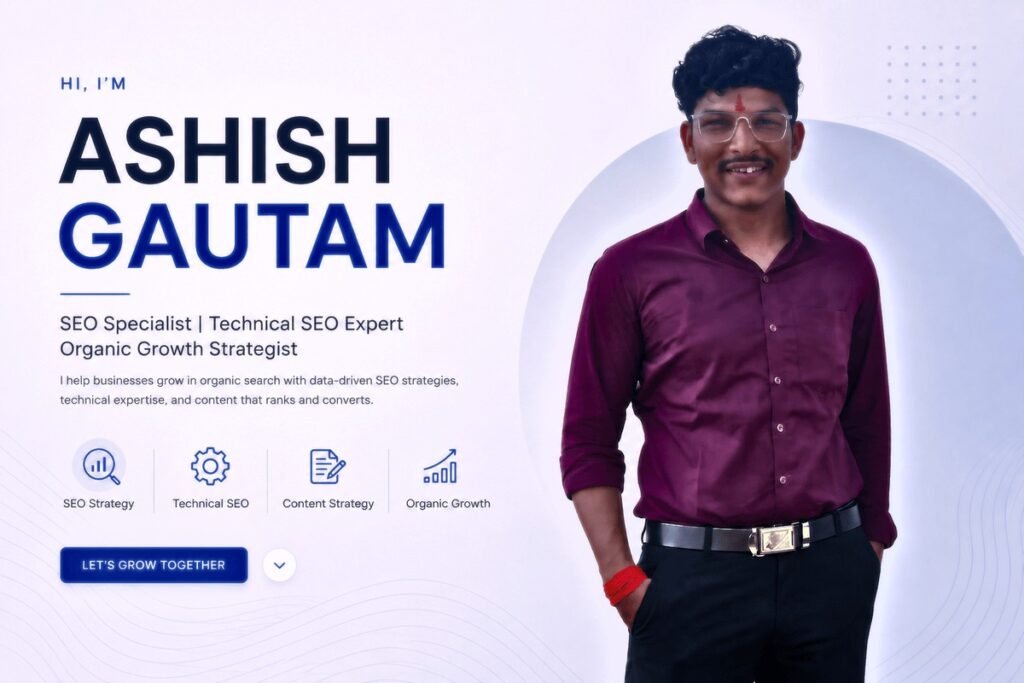
I am an SEO specialist with more than 7 years of hands-on experience in SEO, organic content marketing, technical SEO, and social media. My professional journey has closely intersected with technology and electronics publishing, giving me a unique blend of technical understanding and digital marketing expertise.
Rather than approaching SEO as a checklist of keywords, backlinks, and meta tags, I focus on understanding why a website is not growing, where the organic growth is getting blocked, and what needs to change to fix it.
My experience includes working with technology-focused websites, large content ecosystems, e-commerce websites, and SEO-driven digital properties.
I also publish practical SEO content covering technical SEO and modern search, including a technical SEO blueprint and analysis of SEO wins such as internal linking, content updates, title optimization, featured snippets, and above-the-fold improvements.
My Professional Experience
7+ Years in SEO and Organic Growth
My career has given me approximately 7 years of practical experience in SEO and organic content marketing.
My work has not been limited to one area of SEO. I have worked across:
- Technical SEO
- On-page SEO
- Keyword research
- Content strategy
- Content optimization
- Content pruning
- Internal linking
- Website audits
- Competitor analysis
- Indexing and crawling issues
- Schema and structured data
- Core Web Vitals
- JavaScript SEO
- E-commerce SEO
- WordPress SEO
- WooCommerce SEO
- Link building
- Social media marketing
- AI-search optimization
- Google AI Overviews and emerging search technologies
This breadth is important because modern SEO rarely fails because of one isolated problem.
A website may have excellent content but poor internal linking. It may have thousands of pages but weak indexation. It may rank well but generate poor organic conversions.
My approach is to connect these pieces rather than treat them as separate SEO tasks.
Electronics For You: Combining Technology and SEO
One of the most important parts of my professional journey has been my work with Electronics For You (EFY Group).
My association with the organization gave me experience inside a technology and electronics publishing environment, where SEO has to work at scale across large amounts of technical content.
This background gives me an advantage that many conventional SEO professionals do not have.
That distinction matters when optimizing content about electronics, embedded systems, semiconductors, engineering, hardware, software, and other technical subjects.
Instead of simply inserting keywords into an article, I can evaluate whether the subject itself is technically accurate and whether it is being explained in a way that matches the searcher’s intent.
Check How I Increased ElectronicsForU’s Organic Traffic.
CircuitDigest Experience
I also spent several years working with CircuitDigest, where my work involved technology and electronics-focused content and digital growth.
Working in a technical publishing environment helped me develop another important skill: Turning complex technical subjects into search-friendly content.
Technical SEO and technical content are not the same thing.
Technical content requires subject understanding.
SEO requires understanding search behavior.
My experience sits at the intersection of both.
Education: B.Tech in Electronics and Communication Engineering
I hold a Bachelor of Technology (B.Tech) in Electronics and Communication Engineering from Arya Institute of Engineering & Technology, Jaipur, with my education spanning 2015–2019.
This engineering background has played an important role in shaping my SEO career.
SEO is increasingly technical.
Modern SEO requires an understanding of:
- HTML
- JavaScript
- rendering
- crawling
- indexing
- HTTP responses
- structured data
- websites and CMS platforms
- page performance
- information architecture
- data analysis
An engineering mindset naturally lends itself to this type of problem-solving.
Core Skills
1. Technical SEO
Technical SEO is one of my strongest areas.
My approach goes beyond checking whether a page has a title tag.
I investigate problems such as:
- Crawlability
- Indexability
- Canonicalization
- Robots directives
- XML sitemaps
- JavaScript rendering
- Duplicate content
- Redirects
- HTTP status codes
- Internal linking
- Structured data
- Core Web Vitals
- Page experience
- Faceted navigation
- Pagination
- Orphan pages
- Crawl waste
The objective is simple: Make it easier for search engines to discover, understand, crawl, and index the right pages.
2. On-Page SEO
I have extensive experience optimizing individual pages for both search engines and users.
This includes:
- Search intent analysis
- Title tags
- Meta descriptions
- H1-H6 structure
- Content structure
- Keyword targeting
- Semantic relevance
- Internal links
- Image optimization
- Featured snippets
- Content freshness
- Above-the-fold optimization
My philosophy is that on-page SEO should answer one question: Does this page provide the best possible answer for the searcher?
3. Keyword Research and Search Intent
Traditional keyword research often starts with search volume.
My approach goes further:
Keyword → Intent → SERP → Content Type → User Need → Business Goal
A keyword with 50,000 monthly searches is not automatically valuable.
A keyword with 500 searches may generate significantly more business if the intent is commercial.
This approach allows me to distinguish between:
- Informational searches
- Commercial investigation
- Transactional searches
- Navigational searches
- Problem-based searches
- Long-tail queries
- Emerging search behavior
4. Content Strategy
I specialize in building content strategies around topics rather than publishing random keyword-targeted articles.
My content work includes:
- Topic research
- Keyword clustering
- Content mapping
- Search-intent analysis
- Topic authority
- Content briefs
- Content optimization
- Content pruning
- Content refreshes
- Internal linking
- Competitor content analysis
I believe SEO content should have a purpose.
Every article should ideally answer: Why does this page need to exist?
5. Content Optimization and Pruning
One of my practical SEO strengths is improving existing content and generating valuable content instead of automatically producing more low-value content.
This includes identifying:
- Declining pages
- Cannibalized pages
- Thin content
- Outdated information
- Pages with impressions but poor CTR
- Pages ranking on positions 11–20
- Pages with weak search intent alignment
- Pages that should be consolidated
- Pages that should be redirected or removed
6. E-Commerce SEO
I also have hands-on experience with e-commerce SEO.
This involves a different set of challenges from publishing websites.
E-commerce SEO requires understanding:
- Product pages
- Category pages
- Faceted navigation
- Product schema
- Offers
- Price information
- Availability
- Canonicals
- Duplicate product URLs
- Pagination
- Product variants
- Internal linking
- Indexation
- Merchant-related structured data
My experience with WooCommerce and WordPress also allows me to work directly with the technical implementation rather than treating SEO as something completely separate from development.
7. WordPress and WooCommerce SEO
I have practical experience working with WordPress-based websites and SEO plugins such as Yoast SEO and Rank Math, along with WooCommerce.
This allows me to work across both SEO strategy + implementation, rather than simply delivering recommendations to developers.
That distinction can significantly reduce the gap between an SEO audit and an actual fix.
8. Google Search Console and Analytics
I use search and analytics data to diagnose SEO problems.
This includes analyzing:
- Impressions
- Clicks
- CTR
- Average position
- Index coverage
- Crawled but not indexed URLs
- Search queries
- Page performance
- Traffic trends
- Organic landing pages
My goal is not simply to report numbers.
The goal is to answer: What is happening, why is it happening, and what should we do next?
9. JavaScript SEO
Modern websites increasingly rely on JavaScript.
That creates SEO challenges around:
- Rendering
- Client-side rendering
- Server-side rendering
- HTML availability
- Crawlability
- Indexability
- Dynamic content
- Internal links
- Metadata
- Structured data
My engineering background provides a solid foundation for understanding these technical problems. I talked about this topic in one of my articles.
10. AI Search, GEO, and the Future of SEO
My interests extend beyond traditional Google SEO.
I have been exploring the impact of AI on search, including:
- Google AI Overviews
- AI search
- LLM visibility
- Generative Engine Optimization
- AI-assisted SEO research
- Search intent analysis using AI
- AI content workflows
- Optimization for emerging search interfaces
This is an important part because search is no longer limited to ten blue links.
Users increasingly discover information through:
- AI Overviews
- ChatGPT
- Perplexity
- Gemini
- Other AI-powered search experiences
The SEO professional of the future therefore needs to understand both traditional search engines and AI-mediated discovery.
11. Social Media and Content Marketing
SEO has been only one part of my digital marketing experience.
My professional profile also lists:
- Writing
- Blogging
- Content strategy
- Social media marketing
- SMO
This gives me an understanding of how content behaves outside search engines as well.
Good content can be: searched → discovered → shared → discussed → linked → ranked
Understanding this complete journey is more valuable than treating SEO as an isolated channel.
My Biggest USPs
USP #1: Engineer + SEO Specialist
Perhaps my strongest differentiator is the combination of:
Engineering education + SEO experience.
He understands technology from both sides.
An engineer can understand the technology.
An SEO can understand search.
I combine both.
USP #2: Hands-On, Not Just Theoretical SEO
My SEO experience comes from working with real websites and real problems.
My work involves diagnosing situations such as:
“Why isn’t Google indexing these pages?”
“Why did organic traffic decline?”
“Why are these pages competing with each other?”
“Why is Google crawling these URLs?”
“Why isn’t this content ranking despite having good information?”
This makes my approach more practical than simply following an SEO checklist.
USP #3: Strong Technical + Content Combination
Many SEO professionals specialize heavily in either technical SEO or content.
My experience spans both.
I can move from:
Server/rendering/indexing problem
to:
Search intent/content problem
to:
Internal linking/architecture problem
to:
CTR and SERP optimization problem.
That makes my skill set particularly useful for websites where technical and content problems overlap.
USP #4: Technology-Niche Expertise
My experience in electronics and technology publishing gives me familiarity with complex technical subjects.
That is valuable for:
- Technology companies
- SaaS companies
- Electronics businesses
- Engineering websites
- Developer-focused products
- B2B technology companies
- Technical publications
I do not have to treat technical terminology as a barrier.
USP #5: Problem-Solving Mindset
My approach to SEO can be summarized as: Don’t ask only “What SEO task should I do?”
Ask: “What is preventing this website from growing?”
That shift changes the entire SEO process.
Instead of blindly building backlinks or publishing dozens of articles, I look for the actual bottleneck.
What Makes Ashish Gautam Different From a Typical SEO Specialist?
A typical SEO workflow might look like: Keyword research → Content → Backlinks → Rankings
My approach is closer to: Business goal → Search demand → Search intent → Technical health → Content → Architecture → Internal links → Authority → Measurement → Iteration
This is a much more holistic approach to organic growth.
My SEO Philosophy
My SEO philosophy can be summarized in five principles:
1. SEO is not just rankings.
Ranking #1 is meaningless if the traffic does not contribute to the business.
2. More content does not automatically mean more traffic.
Sometimes the answer is to improve, merge, redirect, or remove existing pages.
3. Technical SEO and content SEO cannot work independently.
Great content cannot compensate indefinitely for serious technical problems.
4. Search intent matters more than keyword density.
The objective is to satisfy the reason behind the search.
5. SEO is becoming increasingly integrated with AI.
The future of organic visibility will involve traditional search engines as well as AI-powered discovery.
My Approach to SEO Problems
When I encounter a website with declining or stagnant organic traffic, I do not immediately recommend publishing more content.
I first ask:
- Is Google able to crawl the website?
- Is Google indexing the right pages?
- Are important pages internally linked?
- Is there keyword cannibalization?
- Are pages matching search intent?
- Is the content actually competitive?
- Are titles generating clicks?
- Are existing pages declining?
- Are there technical rendering problems?
- Is the website targeting the right search demand?
- Is the site’s information architecture helping search engines understand its topical structure?
- Are users actually reaching business-critical pages?
Only after understanding the problem do I decide what action to take.
Who Can Benefit From Ashish’s Expertise?
My skill set is particularly relevant to organizations that need more than basic SEO execution.
Technology Companies
Companies selling technical products often need someone who understands both the product and search.
SaaS Companies
SaaS SEO requires a strong understanding of problems, use cases, comparison searches, integrations, and search intent.
E-Commerce Businesses
E-commerce websites need technical SEO, category optimization, product optimization, structured data, and indexation management.
Publishers
Large content websites can benefit from content pruning, internal linking, technical SEO, information architecture, and scalable content strategies.
Startups
Startups often need an SEO professional who can build the foundation rather than manage an existing checklist.
Me in One Sentence
I am an SEO specialist with 7 years of hands-on experience, combining an engineering background with technical SEO, content strategy, e-commerce SEO, and emerging AI-search expertise to solve real organic-growth problems.
My professional profile is strongest where technology, SEO, content, and problem-solving intersect.
My biggest advantage is not a single SEO skill. It is the combination of skills.
I understand technical websites because of my engineering background.
I understand search because of years of SEO experience.
I understand content because of my publishing and content-marketing work.
I understand e-commerce because of hands-on optimization work.
And I am actively adapting to AI-driven search rather than treating SEO as a static discipline.
That creates my distinct professional positioning:
I am an SEO specialist who can understand the technology, diagnose the search problem, build the strategy, and translate the strategy into practical implementation.
For companies looking for someone who can go beyond keyword research and routine SEO execution, that combination is my strongest USP.
Also read SEO case studies and SEO strategies.