
More impressions do not always mean better SEO performance.
A page can appear for hundreds of keywords, but if most of those searches have little to do with what the page actually explains, those impressions may bring very few clicks.
I took a different approach while working on SEO for Electronics For You. Instead of trying to make existing articles rank for as many keywords as possible, I focused on search intent and the keywords the content could genuinely answer.
I improved existing content, rewrote sections, added missing explanations and tables, updated title tags and meta descriptions, fixed technical SEO issues, improved internal linking, and consolidated overlapping pages.
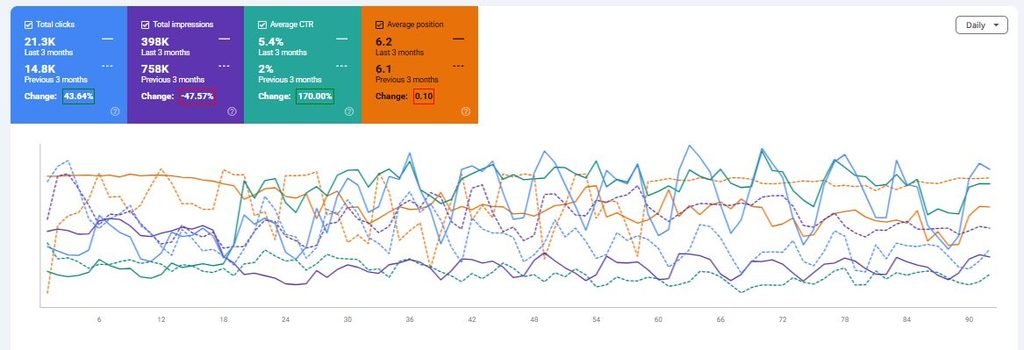
The result was an interesting change in Google Search Console: organic clicks increased by 43.64%, while impressions dropped by 47.57%.
Here is why I believe this is an important lesson for anyone working on content SEO.
The Results: More Clicks From Fewer Impressions
I compared the latest three months with the previous three months in Google Search Console.
| Metric | Previous 3 Months | Last 3 Months | Change |
|---|---|---|---|
| Total clicks | 14.8K | 21.3K | +43.64% |
| Total impressions | 758K | 398K | -47.57% |
| Average CTR | 2% | 5.4% | +170% |
| Average position | 6.1 | 6.2 | Nearly unchanged |
The website generated approximately 6,500 more clicks despite recording around 360,000 fewer impressions.
CTR increased from 2% to 5.4%, while average position remained almost unchanged.
At first glance, the decline in impressions might look like a negative SEO outcome. But these metrics need context.
My approach was to improve the relevance of the content to the searches it was intended to satisfy, rather than chase every keyword that could generate an impression.
The important distinction is between appearing for more searches and appearing for the right searches.
The SEO Mistake: Targeting Keywords the Content Does Not Fully Answer
One common SEO mistake is adding keywords to a page simply because they have search volume or appear in keyword research tools.
A broad keyword may look attractive because it offers a larger potential audience. But if the page only covers a small part of that topic, targeting the keyword may create a mismatch between what the searcher expects and what the page delivers.
For example, an article that explains the basics of a specific electronics component should not automatically target every broad electronics keyword related to that component.
The same principle applies to almost every niche.
A beginner’s tutorial should not try to rank for an advanced troubleshooting query unless it actually provides the required troubleshooting information. A product comparison should not target a broad buying guide keyword if it does not compare the relevant products.
The problem is not that broad keywords are inherently bad. The problem is targeting them without creating content that satisfies the search intent behind them.
A keyword should earn its place in your content. Search volume alone is not enough.
My Approach: Focus on Search Intent and Relevant Keywords
Instead of expanding keyword targeting without considering content relevance, I focused on aligning existing pages with what people were actually looking for.
1. Understand the intent before targeting the keyword
Before targeting a keyword, ask what the searcher expects to find.
Are they looking for a definition, a tutorial, a comparison, a calculation, a product, or a solution to a specific problem?
The page should match that expectation.
A keyword can be relevant to the general topic but still be a poor fit for a particular page. Search intent helps determine whether it belongs on that page or deserves a separate, more comprehensive resource.
2. Cover the topic properly instead of inserting more keywords
I worked on improving existing articles by rewriting sections, adding missing explanations and tables, and making the content more useful.
The goal was to answer the relevant questions clearly, not to include as many related terms as possible.
If a keyword represents an important question that the article does not answer, there are two sensible options: improve the article if the question fits its purpose, or create a separate page if it requires a different treatment.
This keeps content focused while still allowing a website to cover a topic comprehensively across multiple pages.
3. Remove unnecessary overlap between pages
I also worked on duplicate and thin content, internal linking, and content consolidation.
When multiple pages overlap without offering distinct value, it may be worth reviewing whether they should be improved, differentiated, or consolidated.
The objective is not to reduce the number of pages for its own sake. It is to ensure that each page has a clear purpose and serves a meaningful search intent.
4. Align titles and meta descriptions with the actual content
Search-result titles and descriptions should communicate what a page genuinely offers.
I updated title tags and meta descriptions to improve relevance and make the page’s subject clearer to searchers.
A title should not promise a comprehensive guide if the page only offers a brief introduction. Nor should it target a broad keyword simply because that keyword looks attractive in a research tool.
Better alignment helps set the right expectations before someone clicks.
5. Fix technical issues alongside content problems
I also addressed technical SEO issues identified during the project.
Technical SEO and content relevance solve different problems. Technical fixes help address issues affecting crawling, indexing, and page accessibility, while content optimization helps a page satisfy the needs behind a search.
Both deserve attention, but neither should be used as a substitute for the other.
A Real Example: An Electronics For You Article
One example from this work was an article covering SR, JK, D, and T flip-flops.
Read the article on Electronics For You
This is a technical educational topic. Readers may want to understand how different flip-flops work, compare their truth tables, study their circuits, or learn the differences between the four types.
The article needs to satisfy those learning needs rather than simply mention related electronics keywords.
I worked on improving the existing article in several ways.
Rewriting existing sections: I revised sections to improve clarity and make the explanations more useful to readers.
Adding missing explanations and tables: I improved the educational value of the article with additional explanations and tables where needed, helping readers understand and compare the different flip-flop types.
Updating the title and meta description: I refined the search-result messaging to better communicate what the article covers.
Addressing technical issues: Technical SEO fixes formed part of the wider optimization work.
Consolidating overlapping content: I also worked on content consolidation where appropriate, with the aim of reducing unnecessary overlap and giving pages clearer purposes.
The underlying principle was straightforward: make the page a better answer for the searches it should serve.
I did not need to make the article relevant to every electronics-related keyword. I needed to make it genuinely useful for the audience and search intent it was meant to address.
The website-wide Search Console comparison showed higher clicks and CTR over the measured period. However, without the individual URL’s Search Console data, I cannot claim that this specific article generated a particular share of the overall increase.
Why Impressions Can Drop While Clicks Increase
This is the most interesting part of the case study.
Impressions declined from 758K to 398K, while clicks increased from 14.8K to 21.3K.
One possible explanation is that the website stopped receiving as many impressions for broad or less relevant queries while performing better for searches more closely aligned with its content.
For example, a page might receive many impressions for a broad keyword but few clicks because it does not fully satisfy that searcher’s needs. Meanwhile, a more specific query that closely matches the page’s content may produce fewer impressions but a better click-through rate.
When this happens across a website, total impressions can decline even as clicks improve.
That is the outcome my SEO approach was intended to encourage: less emphasis on irrelevant visibility and more emphasis on relevant search traffic.
However, there is an important distinction between the strategy and what the data proves.
The Search Console screenshot confirms the overall changes in clicks, impressions, CTR, and average position. It does not show which individual queries gained or lost visibility. To confirm that less relevant queries declined while relevant queries improved, I would need to compare the query-level data from both periods.
Other factors, including changes in search demand, rankings, and the mix of queries triggering impressions, could also contribute to the results.
Average Position Stayed Almost the Same. Why?
Average position changed from 6.1 to 6.2.
That does not necessarily mean the same keywords retained their rankings.
Average position is an aggregate metric. The website could lose visibility for some queries while improving for others, with the overall average changing very little.
If broad queries lose impressions and more relevant queries gain impressions or rankings, the average can conceal those differences.
This is why I would not evaluate this project using average position alone.
I would examine individual queries and pages to understand which keywords lost visibility, which gained clicks, and whether the gains came from searches that better matched the content.
The objective is not to make every metric increase. It is to understand whether the website is attracting more valuable organic traffic.
How to Apply This Approach to Your Own Website
You can use the same principle when reviewing your own content.
- Export your search queries from Google Search Console. Look at the keywords generating impressions but few or no clicks.
- Check what each query expects. Compare the search intent with the actual information provided on the page.
- Separate relevant keywords from loosely related ones. Do not assume every query is worth targeting just because it has search volume.
- Improve the content where the intent fits. Add missing explanations, examples, tables, or other useful information.
- Create a separate page when necessary. If a query requires a different type of content, forcing it into an existing article may not be the right solution.
- Review overlapping pages. Improve, differentiate, or consolidate them based on their purpose and value.
- Compare clicks, impressions, and CTR over equivalent periods. Then examine the individual queries and pages to understand what changed.
Do not automatically remove keywords or rewrite pages just because their CTR is low. A low CTR can have several explanations, including ranking position, search-result features, query intent, and brand recognition.
The aim is to identify a genuine mismatch, not to optimize every page around CTR in isolation.
The Lesson: Stop Chasing Every Keyword
This project reinforced an important lesson for me: keyword research should guide content creation, not dictate it blindly.
A keyword may have high search volume, but that does not make it a good target for every page. The content needs to provide the answer, explanation, or solution the searcher expects.
By focusing on search intent, improving existing articles, addressing technical issues, and reducing unnecessary content overlap, I aimed to make the website more relevant to the searches it was designed to serve.
The measured result was encouraging: clicks increased by 43.64%, and CTR rose from 2% to 5.4%.
Impressions fell by 47.57%, so the next step is to validate which queries drove those changes. If query-level data confirms that less relevant impressions declined while relevant queries gained clicks or rankings, it would provide stronger evidence for the strategy.
The lesson is not that fewer impressions are always better.
The lesson is that relevant impressions are more valuable than irrelevant visibility, and your content should target keywords it can genuinely satisfy.

I am an SEO specialist with more than 7 years of hands-on experience in SEO, organic content marketing, technical SEO, and social media. I have an engineering degree, giving me an unusual combination of technical understanding and digital marketing expertise. Know more about me.

Pingback: Search Intent Best Practices