
A keyword can have high search volume and still be a poor target for your website.
For example, an article that explains the basics of a technical concept might appear for broad keywords related to the entire subject. But if readers searching those keywords expect a comprehensive guide, a product page, or a different type of information, they may choose another result.
This is where search intent is important.
Instead of trying to rank for every keyword related to a topic, you should identify what people want from a search, examine the results Google displays, and create content that satisfies that need.
This guide explains how to identify search intent, analyze search results, choose the right keywords, avoid common mistakes, and improve existing pages using Google Search Console.
Also check how I increased organic clicks by 43% by focusing on Search Intent.
What Is Search Intent in SEO?
Search intent is the reason behind a search query. It describes what a person wants to learn, find, compare, or accomplish when they search online.
Consider these four searches:
- What is email marketing?
- Mailchimp login
- Best email marketing tools
- Email marketing software pricing
All four relate to email marketing, but they express different needs.
The first searcher wants an explanation. The second wants to reach a specific website or service. The third wants to compare options. The fourth is investigating prices, potentially before making a purchase.
Creating one generic article to target all four keywords would not necessarily satisfy any of these needs particularly well.
The goal of search intent optimization is to make the page a suitable answer to the searcher’s actual need.
Google explains that its systems return results they consider relevant and useful for a query, taking various factors into account. The results can also differ by location, language, and device. Read Google’s explanation of how Search works.
The Four Main Types of Search Intent
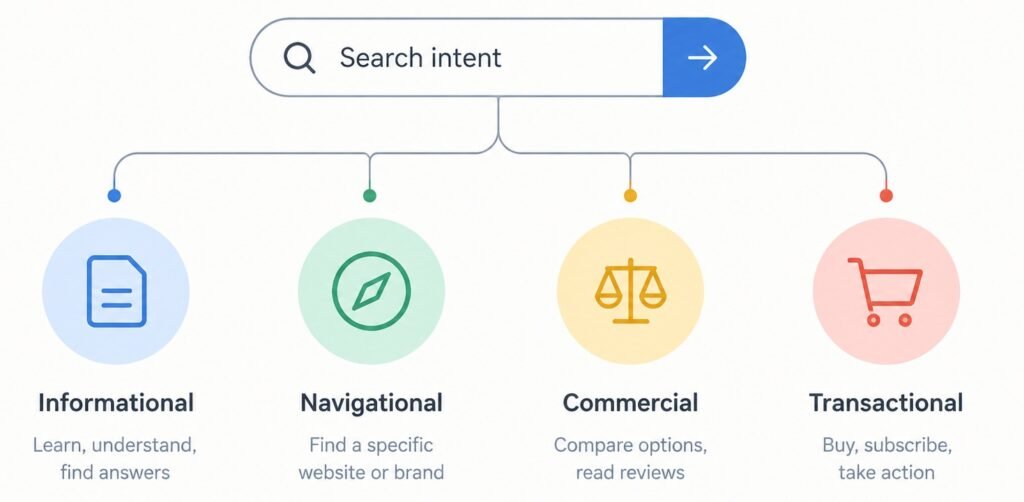
SEO professionals commonly classify search intent into four categories: informational, navigational, commercial, and transactional.
These categories are useful starting points, but not every query fits neatly into one. Some searches have mixed intent.
1. Informational Intent
People have informational intent when they want to learn something or find an answer.
Examples:
- What is search intent?
- How does a flip-flop work?
- Why is my website losing organic traffic?
- How to fix a 404 error
Best content formats: Tutorials, educational articles, explainers, how-to guides, and troubleshooting resources.
The content should answer the main question clearly and provide the necessary explanations, examples, or instructions.
For example, an article targeting “how to fix a 404 error” should explain how to identify the cause and resolve it. A page that only defines a 404 error would not fully satisfy that more specific intent.
2. Navigational Intent
People have navigational intent when they want to find a specific website, brand, or page.
Examples:
- Ahrefs login
- Google Search Console
- YouTube Studio
- Electronics For You
Best content formats: Official websites, login pages, brand pages, and other destination pages.
A person searching for Google Search Console generally does not need an article explaining what the tool does. They want to reach the tool itself.
Creating a generic informational article to target a clearly navigational query is unlikely to be the best strategy when the searcher expects a specific destination.
3. Commercial Investigation Intent
People have commercial intent when they are evaluating options before making a decision.
Examples:
- Best SEO tools
- Ahrefs vs Semrush
- Best laptops for engineering students
- Shopify alternatives
Best content formats: Comparison articles, product reviews, buying guides, and evidence-based recommendations.
These searchers need information that helps them evaluate options. They may want to understand differences, limitations, pricing, features, or which option fits their requirements.
A generic article introducing SEO tools is unlikely to meet the needs of someone searching for a detailed comparison of specific platforms.
4. Transactional Intent
People have transactional intent when they want to take an action, such as purchasing a product, subscribing to a service, or downloading something.
Examples:
- Buy Arduino Uno
- Subscribe to an SEO tool
- Download a PCB design template
- Order electronic components online
Best content formats: Product pages, service pages, pricing pages, registration pages, and download pages.
These pages should make the intended action easy to complete. Relevant information such as pricing, specifications, availability, and purchase options can help users make their decisions.
| Search query | Likely intent | Suitable page |
|---|---|---|
| What is Arduino? | Informational | Educational guide |
| Arduino official website | Navigational | Official website |
| Best Arduino boards for beginners | Commercial | Comparison guide |
| Buy Arduino Uno | Transactional | Product page |
The important lesson is that related keywords do not automatically belong on the same page.
How to Identify Search Intent: Analyze Google’s Search Results
Keyword modifiers such as “what,” “best,” “vs,” and “buy” provide useful clues. However, the wording alone does not always reveal what the searcher expects.
The most practical way to investigate intent is to search the keyword on Google and examine the results.
This approach is often called SERP analysis.
Step 1: Search for the exact keyword
Suppose you want to target the keyword “SEO tools.”
Search Google for that phrase and review the organic results.
Are they mostly comparison articles, individual software pages, listicles, or educational guides?
The dominant page types provide evidence about what Google is displaying for the query.
Do not assume the intent from the keyword alone.
Step 2: Examine the top-ranking pages
Review several of the leading organic results, ideally around five to ten when enough relevant pages are available.
Look for three things.
Content type: Are the results blog articles, product pages, category pages, landing pages, or videos?
Content format: Are the articles listicles, tutorials, comparisons, reviews, or step-by-step guides?
Content focus: What questions do the pages answer? What information appears repeatedly? What do they offer that distinguishes them from other results?
For example, if most results for “best SEO tools” are comparison articles, a basic introduction to SEO tools is probably not the strongest format to target that query.
You may need a comparison article that explains the strengths, limitations, use cases, and costs of different tools.
Step 3: Examine SERP features
Look beyond the traditional organic results.
Depending on the query, Google may display shopping results, local results, videos, featured snippets, People Also Ask questions, or other search features.
These features can provide additional clues about what searchers need.
For example, local business results may indicate that location is important to the query. A prominent video section can suggest that visual demonstrations are useful for the topic.
SERP features are evidence, not absolute proof of intent. Their presence can also affect how many clicks traditional organic results receive.
Step 4: Look for patterns instead of copying competitors
Do not copy the structure of the first-ranking article and assume it will work for your page.
Instead, look for common patterns across several results.
If most competing pages explain a process using step-by-step instructions, that may be an important format expectation. If they all provide detailed product comparisons, your content may need a similar level of comparison to satisfy the query.
Then look for opportunities to improve on what is already available through better explanations, accurate information, first-hand experience, original examples, or a more useful structure.
The objective is to satisfy the searcher’s needs better, not to reproduce the same content.
How to Choose the Right Keywords for Your Content
This is where search intent analysis becomes particularly important.
Keyword research tools can return hundreds of related queries. Some may have high search volume, but that does not mean they belong in your article.
Evaluate each keyword against the actual content you can provide.
Example: An article about flip-flops
Suppose your article explains SR, JK, D, and T flip-flops, including their working principles and truth tables.
Relevant queries could include:
- Types of flip-flops
- SR flip-flop truth table
- JK flip-flop working
- Difference between D and T flip-flops
These queries relate directly to the information discussed in the article.
Now consider a broad keyword such as “digital electronics.”
Although the topic is related, someone searching for it could expect a much broader introduction to digital electronics, covering logic gates, number systems, circuits, sequential logic, and other concepts.
If your article only explains flip-flops, it does not comprehensively cover that broader subject.
The keyword may be related, but the content does not satisfy its full scope.
That does not mean a page can only rank for the exact phrases its author deliberately selected. Search engines can discover relevant variations and queries naturally.
The principle is simpler: do not expand your target keyword list merely because a keyword is related to the topic. Check whether the content genuinely answers the need behind it.
Use this three-question test
Before targeting a keyword, ask:
- What does someone searching this keyword actually want?
- Does my existing page answer that need adequately?
- If it does not, can I improve the page without changing its primary purpose?
If the keyword requires a different page type or a significantly different topic, consider creating a separate page instead.
Search volume and keyword difficulty can help you prioritize suitable targets. They should not decide whether a keyword belongs in your strategy in the first place.
Do Not Add Every Related Keyword to One Article
Finding related keywords is useful, but adding all of them to a page is not a sound content strategy.
Suppose an article about technical SEO receives keyword suggestions covering JavaScript SEO, crawl budget, Core Web Vitals, XML sitemaps, robots.txt, and structured data.
All these topics relate to technical SEO, but they do not necessarily belong in equal detail in one article.
A broad technical SEO guide may introduce each topic and link to dedicated resources. A focused article about JavaScript SEO should concentrate on JavaScript rendering, crawlability, indexing, and related implementation issues.
Use the primary topic to establish the page’s purpose. Include related questions when they help readers achieve that purpose.
Create separate pages when a topic deserves its own treatment and has a sufficiently distinct user need.
This helps establish a clear role for each URL and reduces unnecessary overlap between pages.
Search Intent Is Not Always a Single Category
The four-category model is useful, but real search behavior can be more complicated.
Some keywords have mixed intent.
For example, someone searching for “project management software” may want to understand what the software does, compare available tools, or visit a vendor’s website.
A search for “best project management software for small teams” is more clearly focused on evaluating options, although the searcher may still need educational information before making a choice.
The solution is not to force every keyword into a rigid category.
Examine the actual results and determine the dominant need. Then decide whether one page can reasonably meet that need or whether distinct pages should address different stages of the search journey.
Intent can also vary across markets and over time. Google’s results may differ by country, language, or device, so the SERP you see is not necessarily identical to the one your entire audience sees.
For important keywords, analyze results in the target market rather than relying entirely on a generic intent label from a keyword tool.
How to Find Search Intent Problems in Existing Content
Search intent analysis should not stop after you publish an article.
You can use Google Search Console to identify queries that may reveal a mismatch between the page and what people are searching for.
1. Review the Queries report
Open the Performance report in Google Search Console and select the Queries tab.
Check which searches generate impressions and clicks for your pages.
Ask yourself whether each query is relevant to the page’s actual purpose.
For example, if an article about fixing website errors appears for broad searches about website development but rarely receives clicks, investigate whether those queries represent a meaningful opportunity or simply a loose topical association.
Do not immediately change the content because a query looks unexpected. First, check the search results and determine what the user is likely looking for.
Google recommends examining queries to understand whether your site appears for expected searches and whether important queries could perform better. See the official Search Console performance guidance.
2. Investigate high impressions and low CTR
A page may receive many impressions but few clicks for several reasons.
The title may be unclear. The ranking position may be weak. The search results may answer the question directly. Or the page may be appearing for queries it does not address well.
Separate these possibilities before making changes.
Compare CTR for similar queries and positions where possible. Then inspect the actual results and check whether the title and snippet accurately represent the content.
Google also recommends reviewing whether low-CTR queries are related or unrelated to your website in its Search Console performance optimization guidance.
3. Identify irrelevant impressions
Some pages may rank for queries related to the subject but not to the information they actually provide.
These impressions may contribute little value if they rarely lead to relevant visits.
Group queries into three categories:
| Query group | What to do |
|---|---|
| Relevant queries that already perform well | Preserve what works and look for useful opportunities to improve |
| Relevant queries with weak performance | Review content depth, intent alignment, title, snippet, and competing results |
| Irrelevant or weakly related queries | Investigate why the page appears, then refine the content if there is a genuine mismatch |
Do not rewrite a page simply to eliminate every irrelevant impression. Google determines which queries may be relevant, and occasional unexpected rankings are normal.
Focus on meaningful patterns rather than individual queries with little data.
4. Check for competing pages
Sometimes two pages on the same website address similar search needs.
Review which URL appears for each important query. If multiple pages overlap substantially and neither has a distinct purpose, you may need to improve their differentiation or consider consolidation.
However, similar keywords do not automatically mean two pages compete. One topic can support multiple distinct intents.
Make changes based on the overlap in content, audience needs, and actual search performance.
Common Search Intent Mistakes: Do’s and Don’ts
| Do | Don’t |
|---|---|
| Review the current SERP before targeting an important keyword | Assume the intent from the keyword wording alone |
| Match the page type to the dominant search need | Force a blog post to target a keyword dominated by product pages |
| Target keywords the content can genuinely satisfy | Add broad keywords only because they have high search volume |
| Use related questions to improve the article’s usefulness | Add every People Also Ask question regardless of relevance |
| Create separate pages for distinct search needs when appropriate | Force multiple unrelated intents into one article |
| Review query-level performance in Search Console | Assume every low-CTR query indicates a content problem |
| Compare competitors to identify user needs and content gaps | Copy competing articles without adding original value |
| Improve content when it no longer meets the intended need | Rewrite successful pages without a clear reason |
Google’s people-first content guidance supports a similar principle: create content that helps people accomplish their goals rather than producing pages primarily to attract search traffic.
Content Gaps: Questions Many Search Intent Guides Do Not Fully Answer
Many introductory guides explain the four intent categories and recommend reviewing Google results. That is helpful, but readers also need answers to the practical decisions that follow.
These are useful questions to address in a comprehensive search-intent resource.
Should I target every keyword related to my main topic?
No. Target keywords that fit the page’s purpose and that your content can answer adequately. Related keywords are not automatically relevant targets.
Can one article target multiple search intents?
Yes, when those intents are compatible and the page can satisfy them without losing focus. For example, an informational guide may include a brief comparison section. But an extensive purchase-focused intent may deserve its own page if the needs differ significantly.
Should I create a new page for every related keyword?
No. Several closely related keywords may express the same underlying need and can often be addressed by one page. Create separate pages when the intent, expected format, or information required is meaningfully different.
Does a low CTR prove that my content does not match search intent?
No. CTR can be affected by ranking position, search features, titles, snippets, brand familiarity, and the specific query. A mismatch is one possible explanation, not an automatic diagnosis.
Can irrelevant impressions hurt SEO?
An irrelevant impression does not automatically harm rankings. However, repeatedly targeting queries that your content cannot satisfy is a poor content-planning strategy. Review unexpected query patterns to decide whether the page needs improvement or whether the queries are simply incidental.
Should I remove a keyword from a page if it generates no clicks?
Not necessarily. A query may have few impressions, rank too low to attract clicks, or serve a useful audience despite limited traffic. Evaluate relevance, demand, rankings, and business value before making a decision.
These questions address a practical gap between knowing what search intent means and using it to make defensible content decisions. To prioritize them for a particular audience, validate demand with Google autocomplete, People Also Ask, relevant searches, keyword research tools, and your own Search Console data. Their inclusion here should not be interpreted as verified search-volume or People Also Ask data.
A Simple Search Intent Workflow
Use this process before creating a new page or substantially updating an existing one.
Step 1: Define the user’s goal. Write down what the searcher wants to learn, compare, find, or accomplish.
Step 2: Review the SERP. Examine the top organic results, their content types, formats, and focus. Note relevant search features.
Step 3: Choose the right page type. Decide whether the need calls for a tutorial, comparison, product page, landing page, or another format.
Step 4: Evaluate your keywords. Keep relevant queries that fit the page’s purpose. Do not target broader topics that the page cannot adequately cover.
Step 5: Identify information gaps. Compare your planned content with the needs evident in the SERP. Add useful explanations or examples that improve the answer rather than padding the article.
Step 6: Publish and measure. Use Search Console to examine clicks, impressions, CTR, and position, then review individual queries to see whether the page attracts relevant searches.
Step 7: Refine with evidence. Update the content when there is a genuine mismatch or an opportunity to answer an important question better. Avoid making changes solely to chase every keyword variation.
Final Thoughts
Search intent is not just another keyword classification exercise. It is a way to decide what content to create, which keywords deserve attention, and whether an existing page genuinely meets the needs of its audience.
The best approach is to study the search results, understand the questions behind the keywords, and make sure your content delivers the information those searchers expect.
Do not chase a broad keyword simply because it has a large search volume. Do not add every related query to an article. And do not assume every impression is equally valuable.
Focus on the searches your content can genuinely satisfy. That is a better starting point for useful content, relevant organic traffic, and a more focused SEO strategy.

I am an SEO specialist with more than 7 years of hands-on experience in SEO, organic content marketing, technical SEO, and social media. I have an engineering degree, giving me an unusual combination of technical understanding and digital marketing expertise. Know more about me.
Pingback: How I Increased Organic Clicks by 43% by Focusing on Search Intent
Pingback: 5 SEO Mistakes You’re Still Making and How to Fix Them
Pingback: How to Rank Higher Without SEO Hacks
Pingback: SEO Is More Than Rankings: Why Branding Matters