Stop Faking Freshness: How Google Really Detects Content Updates

Google doesn’t care when you say you updated a page. It cares whether you actually changed something meaningful. Fake freshness can hurt your rankings more than no update at all.
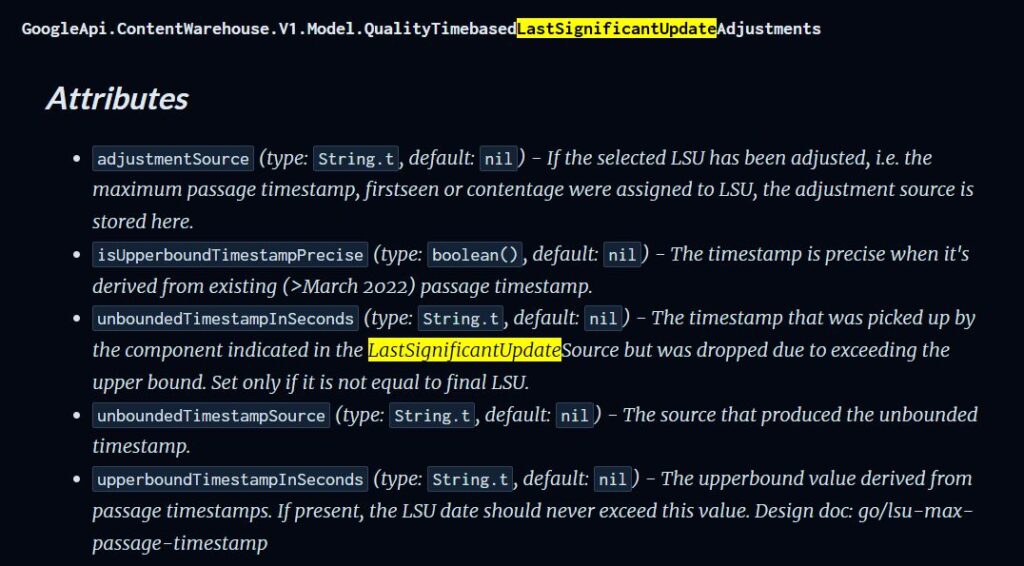
The image shows internal attributes tied to:
LastSignificantUpdate
This is not just “last modified date.” It’s Google’s way of tracking:
“When did this page actually change in a meaningful way?”
Key signals from the attributes:
- adjustmentSource
→ Where the update signal came from (content change, timestamps, etc.) - isUpperboundTimestampPrecise
→ Whether Google trusts the timestamp accuracy - unboundedTimestampInSeconds
→ A detected update that got rejected (too extreme or unreliable) - upperboundTimestampInSeconds
→ The maximum allowed freshness based on real signals
→ Your page can’t claim to be fresher than this
That means Google is validating, correcting, and sometimes rejecting your freshness claims.
The uncomfortable truth most SEOs ignore
You changed the publish date.
You hit update in WordPress.
You expected rankings to bounce.
Nothing happened.
Or worse, your rankings dropped.
That’s not random. That’s Google quietly saying: “Nice try, but nothing actually changed here.”
The real problem: Fake freshness is everywhere
Let’s take a simple example.
You wrote: “Best Laptops 2024”
Now it’s 2026.
Instead of rewriting the content, you just:
- Change the date to 2026
- Maybe tweak a line or two
From your side, it looks updated.
From Google’s side, it looks like manipulation.
What Google actually tracks (and why you should care)
Google doesn’t rely on timestamps anymore. That’s outdated.
It uses something closer to a “Last Significant Update” concept.
In simple terms:
Google checks whether your content changed in a way that matters to users.
It looks at things like:
- New entities (products, tools, brands)
- Updated stats or data
- Content structure changes
- Internal linking shifts
- Historical page versions (yes, Google remembers)
If nothing meaningful changes, your “update” doesn’t count.
Why changing the date alone is risky
Here’s where it gets serious.
If you repeatedly fake updates:
- Your page loses trust
- Then your domain loses trust
- Then your entire niche performance suffers
Google may trigger what SEOs call a date unreliability signal.
That means:
Even your real updates might stop getting credit.
Real-life scenario (this happens all the time)
Two websites targeting: “Best AI Tools”
Website A:
- Updates date every month
- No real changes
Website B:
- Adds new tools
- Removes outdated ones
- Updates pricing and features
- Improves comparisons
Guess who wins?
Not the one gaming the system.
How does Google decide if your update is “Real”?
Think like this:
A weak update:
- Fixing typos
- Changing a few sentences
- Updating the publish date
A strong update:
- Adding new sections
- Replacing outdated content
- Updating data, stats, and examples
- Improving depth and clarity
If a user can’t notice the update, Google won’t either.
The hidden system: Google learns your update pattern
This is where most people miss the game.
Google doesn’t just analyze what you update.
It also learns how often you update.
Example:
- You update a page every 30 days → Google expects that pattern
- You suddenly stop → crawl frequency drops
- You suddenly spam updates → trust drops
This is called change frequency modeling (not official term, but very real behavior).
Actionable SEO strategy (what actually works)
1. Update for value, not for signals
Before updating, ask:
- Is this still accurate?
- Is there anything new in this space?
- Would I trust this as a user today?
If the answer is no, don’t just update—rewrite.
2. Add visible freshness
Make updates obvious.
Do things like:
- Add a “What’s New in 2026” section
- Update comparison tables
- Include latest data or trends
This helps both users and Google.
3. Match content type with update frequency
Not all pages need frequent updates.
- Evergreen content → update rarely
- SEO/marketing content → update quarterly
- AI/tools/product content → update monthly
Trying to update everything often is a mistake.
4. Remove outdated content (don’t just add)
Most people only add new info.
Smart SEOs:
- Remove irrelevant sections
- Replace outdated tools
- Clean up old data
Updating is not adding. It’s improving.
5. Be consistent
If you build an update pattern, stick to it.
Consistency builds trust.
Random updates create confusion—for both Google and users.
The contrarian truth
Most SEO advice says:
“Update your content regularly.”
That’s incomplete.
Here’s the better version:
“Update your content only when you have something worth updating.”
More updates ≠ better rankings. Better updates = better rankings.