ChatGPT referral tracking has come under scrutiny after website owners and SEO professionals reported that links from ChatGPT were no longer consistently carrying the utm_source=chatgpt.com parameter. The issue made it harder to identify traffic coming from ChatGPT in analytics reports.
However, as of October 16, 2026, I could not verify an official announcement confirming that OpenAI has resolved the issue across ChatGPT.
What Happened to ChatGPT UTM Parameters?
In October 2026, SEO professionals began reporting that some links opened from ChatGPT were missing UTM tracking parameters and referral information.
The issue attracted attention following the GPT-6 rollout. When a website receives a visit without a tracking parameter or referral information, analytics tools may be unable to identify ChatGPT as the source.
As a result, some visits that previously appeared as ChatGPT referrals could instead show up as direct traffic.
Search Engine Roundtable reported the issue on October 14, citing observations from Adobe’s Cedric Huesler. Search Engine Land also covered the tracking problem on October 15.
Sources: Search Engine Roundtable and Search Engine Land.
How Much Traffic Was Affected?
Cedric Huesler examined approximately 500 pages where ChatGPT had previously contributed at least 5% of visits.
Comparing October 9–13 with the preceding week, his analysis reported:
- ChatGPT traffic: Approximately 31,000 fewer visits per day.
- Direct traffic: Approximately 26,000 additional visits per day.
- Direct traffic increases: Two-thirds of the pages losing ChatGPT-attributed traffic also experienced an increase in direct visits.
These figures come from a limited sample, not a complete measurement of all websites. They also do not prove that every missing ChatGPT referral became a direct visit.
The findings nevertheless highlight a major challenge for marketers: a decline in reported AI referral traffic does not necessarily mean fewer people are visiting a website.
Why Does This Matter for SEO?
UTM parameters help analytics platforms identify the source of a website visit. Without them, and without a usable referrer, marketers may lose visibility into how people discover their content through AI platforms.
This affects several areas:
- AI traffic reporting: ChatGPT referrals may be undercounted.
- Content performance: Publishers may struggle to measure visits generated by AI recommendations.
- Marketing attribution: Businesses may find it harder to connect AI discovery with leads and sales.
- SEO reporting: Teams may mistake a tracking problem for a decline in visibility or demand.
For websites investing in generative engine optimization (GEO) and AI search visibility, reliable referral attribution is important for measuring results.
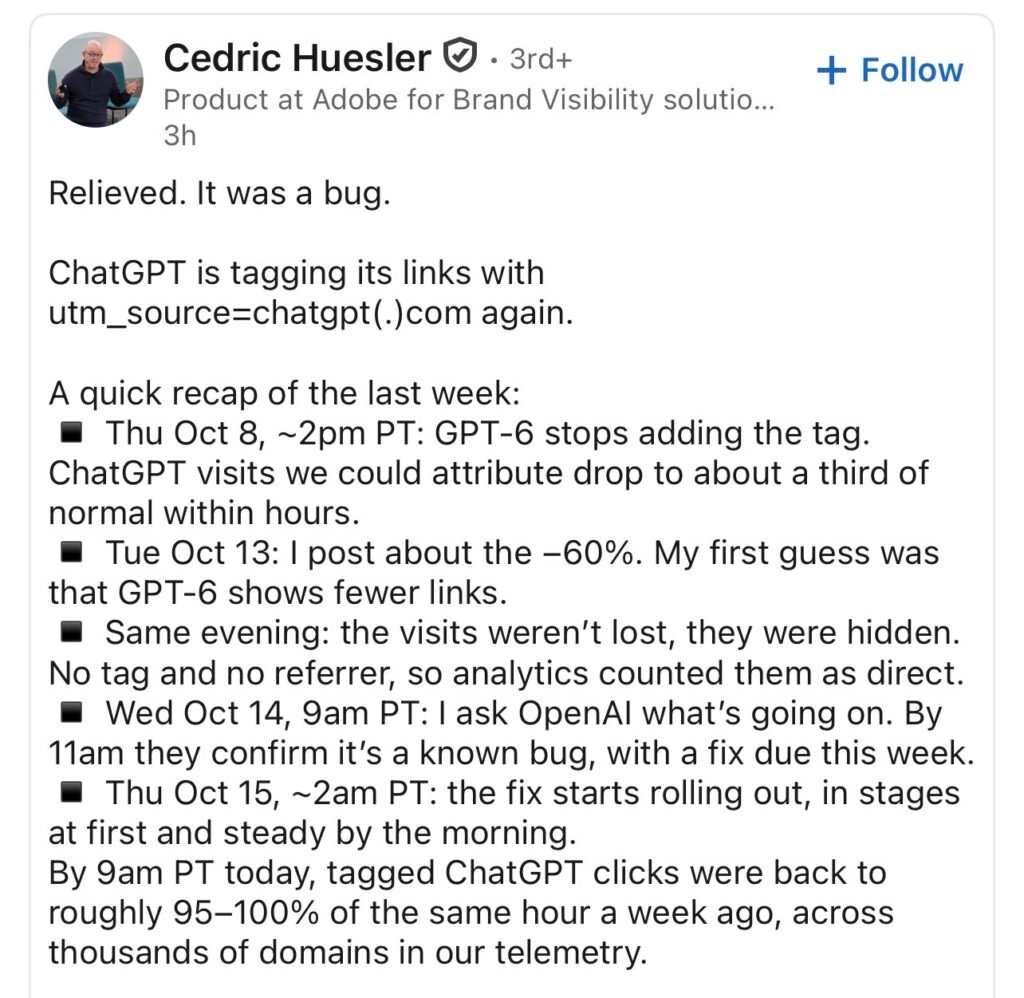
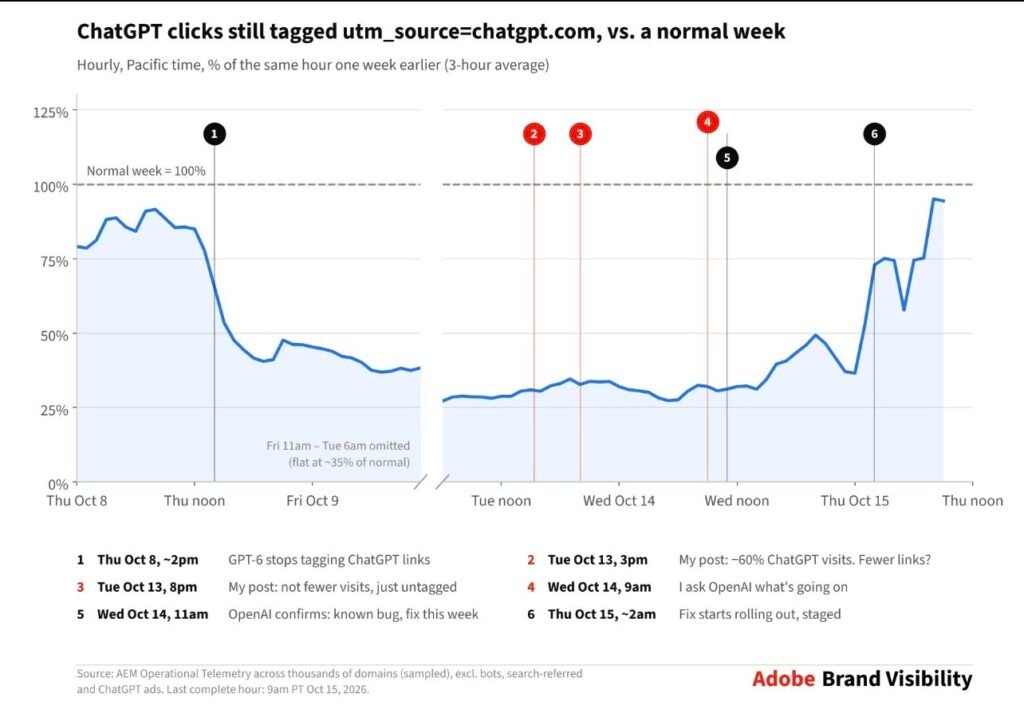
Has OpenAI Fixed the ChatGPT UTM Issue?
Cadroc Huesler from Adobe shared the update on Linkedin regarding this issue. He mentioned that utm parameters are started rolling out again. So this issue is resolved now. Below you can see the screenshot of his LinkedIn post.
What Should Website Owners Do Now?
Until consistent tracking is confirmed, website owners should:
- Monitor ChatGPT referral traffic and direct sessions in GA4.
- Compare landing-page trends before and after October 9.
- Test outbound links from different ChatGPT interfaces and devices.
- Keep historical analytics data so attribution changes can be investigated later.
- Avoid making major SEO decisions based only on a sudden decline in reported ChatGPT referrals.

I am an SEO specialist with more than 7 years of hands-on experience in SEO, organic content marketing, technical SEO, and social media. I have an engineering degree, giving me an unusual combination of technical understanding and digital marketing expertise. Know more about me.